Home

Search This Blog

Saturday, July 17, 2010

"Changing to the Past" Day One of Three

This year I am working to discover new water and to go back and fish some water that I haven't been to in a few years. It can be frustrating and it can be rewarding. But heck, even when I go places I have been to in the past, places that "I'm sure" I'm going to catch fish, I don't always catch fish. Go figure. I think that I have gotten pretty good at catching Carp on the fly. That means I want to catch Carp every time I go out.

I got out last week for three days of discovery and rediscovery. I left home later than I meant to so after the 3 hour drive to the river it was already 11:30. Okay, so I was lollygagging, big deal.

On day one I started at a place I have fished but not for three years. It is actually a gorgeous piece of water. I have caught fish there in years past so this isn't quite the risk that going to some place totally new is. I saw a few fish jump a ways out in the river and I saw three fast cruisers. That was it for almost three hours of wading. That seems so unfair to me. How could a thing like that happen to me? Most people are way better looking than me but still, I'm one of the nicest guys I know. How come those dang Carp weren't there? I've caught fish there before. There were pock marks all over everywhere. Where the heck were they today?

I drove down the river to some new water that I have wanted to try for years. From the highway it sure looks good. I parked at what looked like an easy access point. As it turned out I walked for over an hour and a half but never really found a good place to get into the margins of the river without immediately being in deep water. It was a surprise because the bank was so level. At the end of the day I had not seen a single tailing fish. Not one! Grrr....I ain't pretty, but I'm pretty dang nice; stuff like that shouldn't happen to me.

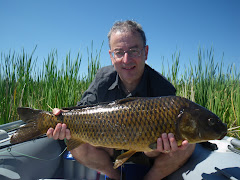
Here is a picture of me holding all of the fish I caught today.


Days two and three are coming.

Friday, July 16, 2010

Klint's Comment about the San Juan Worm

This is a continuation of my conversation with Klint from Washington State. Klint wrote in two emails: "My best fly has been the SJW. I have tried quite a few other patterns but the fish just react better for me when I am fishing a worm. I have yet to find a fly other than the SJW that carp will even look at." The SJW is definitely a consistent producer--as consistent as any Carp fly can be. Nothing works all the time. Some flies work some of the time. Some don't work at all. I started a blog post months ago about great flies that don't work for Carp. I have experimeted with flies for Carp that have produced well for other species and can't get a take from a Carp. I'll finish that post someday. I think that the seasoned Carp fly rod angler, at least in the Pacific Northwest anyway, should always have some SJW's in his box. They don't always work and sometimes other flies do actually work better. Somedays the SJW definitely works better. I would say one thing about the SJW worm versus most other Carp patterns. I fish them differently and so do the guys I know who also use them. I tend to be willing to let the SJW sit longer than I do a Carrot, a Carp Woollie, or pretty much anything else I use. I fished a few days last week and did not get a fish on the SJW. I got them all on Carp Carrots and Black Betty's. It probably was an even split. I would also say that if you come on what my friend Keith calls, "a violently tailing fish" and you can put the SJW on his dinner plate then you have as good a chance of getting that fish to take as with any other pattern and maybe better. Think of the space around the front and sides of a tailing fish as a dinner plate or spaghetti platter. They typically won't move far to pick up a fly even when they see it. If it's on their dinner plate then get ready to set the hook. I do think that fish that are cruising slowly, or more importantly, ones that are what I call shopping, are a bit more likely to pick up something else than a SJW but I'm not sure of that. A fish that I see stop and pick something up and then move a bit to look for something else to eat, are what I call shoppers. When it comes to picking up fish in the water column versus on the bottom, I think that the SJW isn't as effective here. John Montana, what's your take on this? All of that said, at any one time I always have 3 dozen SJW's with me when I'm Carp fishing. It's a go to Carp fly to be sure.

Thursday, July 15, 2010

Grass Carp Flies: Part I


Here in Washington State there are Grass Carp in a few lakes both public and private. The Grass Carp that are here are all supposed to be certified sterile so they can't reproduce. Stocking Grass Carp in any Washington lake, both public and private, requires the permission of the Washington State Department of Fish and Wildlife.

Lone Lake is a place I have fished since the early 70's. Yikes, is that possible? I have fished it for Trout. It is on an island here in Western Washington. Through the years the property around the lake has been developed more and more as has the rest of the island. Some years the Trout fishing has been better than others with some years being disappointing and not worth the effort and some years being quite amazing for a lake that a guy can drive to.

Several years ago the lake began to be infested with Brazilian Elodea. As it proliferates it can just choke a lake.

I am a member of the Evergreen Fly Fishing Club; many of our members regularly fish Lone Lake for Trout. As the Elodea problem became worse and worse our club, along with the local Homeowners Association, another fly club, and the WDFW, worked to remove the weeds. Elodea is just darn difficult to eradicate. After much research and consideration it was decided that the WDFW would plant Grass Carp in Lone Lake. The goal was to keep the elodea down but not eliminate all aquatic plant life.

Grass Carp are vegetarians; they love their salad. They will eat a bug but not very often by comparison. Well, in a matter of just four years the salad eaters have cleaned out the lake. There are no plants left growing from the bottom. There are some cattails and other weeds at the margins but that is it. The lack of aquatic vegetation is now causing other problems in Lone Lake. To help mitigate this the WDFW has approved a Grass Carp removal program at Lone Lake. People who are participating in the removal process had to be part of a permitting process. We even have to carry a sign and a badge of sorts while we fish.

I have caught a good many Common Carp and Mirror Carp. I have caught a grand total of 5 Grass Carp on the fly. That was several years ago. I know a guy who has some private lakes on his property. He had a permit to plant some Grass Carp in his water. He asked me to try and catch a few of them to move them from one lake to another to help with weed control in the lakes where they were not getting the job done. I spent a couple hours one day observing their behavior and then returned with my son to have a go at it.

We fished the better part of the day; those Grass Carp are not easy to catch. They are very spooky. We were only able to catch them when we were hiding behind the cattails, casting very carefully, and then letting the fly sit for awhile before stripping extremely slowly.

We fished floating lines and 1X leader. I believe we caught 7 total; it may have been 8. I tried some Olive Woolly Buggers and a few other leech style pattersn. We caught our fish on my Scum Fly. We just let it sit there. I should add that later in the day we started greasing the leader so it would float which helped keep the fly near the surface.

Knowing how hard the Grassers are to catch on the fly I was not terribly optimistic when I went to Lone Lake a few weeks ago. The weather was cloudy and cool. I had some Scum Flies but I also was trying something new, the Grass Fly. Katy brought home some Sushi. A few of the pieces were sitting on a strip of fake grass. I went to the grocery store the next day and asked the guy if he would sell me a few strips of fake grass. He said no but he told me where I could get 60 piecs. It cost me $1.50. I cut it in to grass blade size strips and tied it on a #8 5262. Dang I thought that fly would look tasty to a Grass Carp.

I spent a couple hours slowly moving around the edges of the lake looking for Grassers. I cast to where I thought there might be some but not knowing for sure reduces your odds considerably and they aren't good to start with.

Remembering my time from 10 years ago on the private water I finally saw evidence of a Grass Carp. If I hadn't seen it several times back then I wouldn't have known what the heck was happening. I saw the top of a reed moving slowly through the water. It would move, stop, and then move again. Then it would sink a little and then disappear. I remembered that Grass Carp can pick a two or three foot reed, hold it in their mouth, move for awhile, eat some of it, move some more, and finally eat it all. They can root around in the margins and pick a reed off like breaking off a celery stalk. Sometimes after they break one off they will move away before they begin eating it. Kind of like a Sea Gull or a Crow trying to get away from other birds before it begins eating whatever it has found. I also saw something else that I knew told me there were Grass Carp in the area. A reed would appear to be floating flat on the top of the water. It would slowly move even against the wind. It would slide across the top of the water with one end slipping below the surface.

Picture yourself with an two foot french fry in your mouth. You are holding the loose end with one hand. You don't move the fry with your hand, you just nibble it a bit at a time. You nibble in half inch to one inch increments. Slowly the french fry moves towards you as you eat it. That's what it is like when a Grass Carp is nibbling on a 2 foot reed. The fish will be just subsurface and the only evidence you might see is the moving french fry. If the sun is out and the sky is clear, and of course it helps if the water is clear, you can see the Grass Carp eating. They do NOT like company. They don't like noise, they don't like shadows, they don't like movement. Don't take this personally but they don't like me or you either.

I did not catch a Grass Carp in Lone Lake when I was out a few weeks ago. I hope to try again but alas, I am very distracted by my friends the Commons and the Mirrors.

I am anxious to see if my Grass Fly will work when the Grass Carp are more active. I may have to resort to tying lettuce to my hook. Maybe I'll tie a bit of bacon and a small tomato wedge with the lettuce and I'll have the BLT fly. Probably not.

Mr. P.'s Scum Fly

Hook: Tiemco 5262 size 8
Thread: Black or Olive
Body: Olive Crosscut Rabbit Fur
Scum: Scribbles 3D Hunter Green Paint

Tie the rabbit fur on near the bend of the hook. After each wrap seperate or pull the fur out from the hook shank. At random points spread the paint in the fur with a toothpick.

Here are pictures of the same Scum Fly from four different angles. In the water it looks like scum or algae.


All five Grass Carp I have caught were taken on my Scum Fly.

Here is a picture of my Grass Fly.


This is a picture of the box the fake grass comes in with one piece sitting next to it.


Grass Fly:

Hook: Tiemco 5262 size 8
Thread: Black or Olive
"Body": Fake Grass

Cut blades of fake grass from the sheet. Fasten them in different directions.

Saturday, July 3, 2010

Gerhard's Questions and a Few Answers

This post and the two preceeding it are answers to emails from readers. I have cut and pasted the emails.

Caller three is Gerhard who is from Aurora, Ontario. Go ahead caller:

"Mr. P.,

I tremendously enjoy your web site and the information provided.
My fishing is primarily done in Southern Ontario, Canada and the metropolitan Toronto area, where favourite spots are storm water ponds with sometimes impressive and very picky carp. The Great Lakes also hold very big fish but they are hard to find in the summer, especially in lake Ontario with the exception of the Bay of Quinte maybe.

The carp carrot is very good fly in some areas, especially with crayfish I believe, but sometimes other colours might be preferable, like olive or green or even black. In your blog you mention different colours, but it does not say anything about what goes together like the orange body and yellow hackle for the carrot.
Do you use yellow pheasant for all other body colours as well or are there other combinations recommended? It would be interesting to get your view on this as when I switch colours now it also means a different pattern. I really would like to see how far the carrot could go, even around here.

Thanks for your thoughts and please keep up the excellent site."


Some answers (and a couple questions of my own):

Thanks for the props about my blog Gerhard; I'm glad you enjoying reading it. I enjoy writing it. Is the water you fish clear, somewhat cloudy, or muddy? Do you wade or fish from something that floats?

Yes, I have tried several other body colors of the Carrot. Variations I have used successfully are red, brown, black, burgundy, white, green, olive, and peacock.

For the hackle on these other variations I have used natural pheasant, pheasant dyed olive, wine, black, green, crawfish orange, purple, and black. I have tied Carrots and the variations with partridge and like using it also.

Natural Pheasant:


Pheasant Dyed Yellow:


As to preferences I still like the orange body with the pheasant dyed yellow best of all. Olive and peacock versions have been good to me along with black and burgundy. I didn't start this blog until 2009 but had been fly fishing for Carp for many years before that so I have had a chance to experiment with a lot of different patterns before I was blogging.

It sounds funny to me Gerhard to call a black version of my Carrot, a Carrot. I don't know what to call it, a Black Carp Carrot I guess; I don't know. I have tied the black bodied version with natural pheasant and black pheasant. I like them both.

In my typed fishing journal, the first time I used the green version I wrote, "I caught some fish today on a 'Green Carrot'--what do I call it, 'Celery'"? Heck a guy could fish a topper and a dropper and be fishing with Carrot and Celery.

I have tied the green and olive bodied ones with green, olive, black, and natural pheasant. What do I like in this group? I think the olive body and olive hackle in this group.

I have tied the peacock bodied fly with an olive and natural hackle, along with a black hackle. Pheasant died black turns out in a surprising way. It has a peacock kind of shimmer to it and changes color as it catches light differently. I use the heck out of the pheasant died yellow but also really like the black. The black is easy to find by the way. A peacock herl body with a black pheasant rump hackle is my favorite in this group. It's not really all black but I call it Black Betty.


Pheasant Dyed Black:


Here is a Black Betty.


And here it is with a red tail.


As an aside, I have fished a peacock body fly with a palmered brown saddle hackle for decades. I tie it very sparsely by stripping barbules off one side of the feather. For durability I counter rib it with fine wire. I have used this for trout and am going to try it for Carp this year.

For the red, brown, black and burgundy, I have used mostly the natural pheasant hackle and also a partridge hackle.

The white version I have only tried half heartedly. My friend, Keith, fishes a white fly that looks like a grub with a tail. I have tied this and fished it but honestly not very much.

I have experimented a bit with purple, crawfish orange, and wine hackles on brown and black bodies and I've also tried the wine hackle on a burgundy body. I haven't done this much so I don't have any thoughts on them.

A Whole Skin Dyed Purple:


Pheasant Dyed Crawfish Orange:


As I said, I use the heck out of pheasant dyed yellow. I use it for Carp flies but also for Trout flies. Several years ago I took a couple "empties" back to the fly shop and told the owner I was there to complain about a couple bad pheasant rump patches he had sold me. He showed genuine concern and asked what was wrong with them. I took them out of the bag and told him they didn't work anymore; they were empty. He laughed and told me he sold refills. I bought two refills and put them to work the same day.

Two Views of An "Empty":


I am committing myself this year to at least one, three day trip where I only fish new water. On that trip I have been telling myself that I am going to really work to fish two or three flies, or versions of flies, that don't usually get first billing when I'm out. If I'm getting shots at tailing fish and they won't take, well then it will be a good day of learning for me with some new flies, or flies I am revisiting. In particular I am going to fish Black Betty, the peacock body fly with the pheasant dyed black, and the olive body with olive or black hackle. I have caught Carp on these flies before but they have taken a back seat the last few years. Its time to bring 'em back.

Thanks again for your email Gerhard.

It is drizzling lightly here at home. I am dreaming of warm Carping days in the weeks to come.

Saturday, June 26, 2010

Robert's Questions and a Few Answers

Caller two is Robert, from Minnesota. Go ahead caller:

"Really enjoy your blog Mr. P. I like the stories and the information and I like your humor. I really enjoy your photography too. I love the one of the reel and the fish underwater. Sounds like you mostly fish clear water and can see the fish you're casting to. Your underwater pictures make it look that way also. Is that true? Around here our water is cloudy. There are Carp feeding and what I see is a bubble column rising up from where they are. I cast to the bubble columns and catch fish but usually the fish are snagged and haven't taken the fly. It sounds like the fish are taking your fly and you can see them take it. Wish we had that here. Do you fish any water that is cloudy? What flies do you feel work well in muddy conditions? Any thoughts on detecting takes when you can't see the fish? Thanks."

Thanks for the email Robert. Some of the water I fish varies in clarity a great deal. The Columbia River can be very clear one day, somewhat clear the next day, and have almost no visibility another day. There is an old saying, "The best time to go fishing is when you can." For me that means that sometimes I go when the conditions aren't the best and I just deal with it. When I know conditions are going to be bad sometimes I choose to not go and wait for a better day.

I say these next things cautiously and respectfully. I much prefer to fish in conditions where I can sight fish. I wrote in my fishing journal in the 80's that "the take is the premier moment." It was true then and it is even more true for me now. Hunting and stalking Carp is riveting. Seeing them take is such a rush. If you live somewher where all of the water is cloudy all of the time then there isn't much you can do about that except drive a long ways to find clear water.

I live in Western Washington. Going away the best Carp fishing is on the other side of the state. I drive a minimum of three hours to get to various spots on the Columbia. It is a five hour drive for me to get to Banks Lake. There is another lake in Eastern Washington that I chase Carp in. I have been there probably 25 or 30 times. Being in that part of the state makes things a minimum of 3 hours and often more. I just take for granted now that I have to drive to find Carp in clear, or somewhat clear water. I ask this question respectfully because I know it can be easier said than done. Are you able to drive to find Carp in clear water? I think it is worth the time.

Each of the last four years I have fished different, new water that was completely cloudy. I understand this to be what they call brownlining. All four times I would say that the spots truly had too many Carp. I had a couple guys ask me how I could say that a spot had too many Carp. My best example is from three years ago. I was fishing the Columbia one day and this guy pulled into the area I was parked. He was a PUD lineman and he stopped for lunch. When I am asked what I am fishing for sometimes I say, "whatever bites", and sometimes I say, "Carp". It just depends on how I think the conversation will go. When this guy asked I smiled and said, "Carp." He immediately answered and said, "Do you want to know the best Carp lake in the whole world?" Well of course I did so I said, "yes". Wow, think of it, the best Carp lake in the whole world, right here in Washington. He said that it was called Cougar Lake and that it was filled with Carp. He even gave me directions. I went there the next day. The lake was as he said, just teeming with fish. I caught 13 Carp. Okay, I have done that in the past but I had never caught 13 Carp in 13 casts before. But here's the thing, it wasn't any fun at all. Twelve of the thirteen fish were snagged. Only one of them had picked up the fly. The fish that had eaten the fly really wasn't any more fun to catch than the other ones because I really couldn't tell if he had taken the fly until he was very close to me. Two of the fish were snagged below their lip but that is still a snag. I don't really count snagged fish as caught fish but more to the point snagging them takes the joy out of it.

A few weeks later I went back to Cougar Lake one more time with my son. I wondered, as you do, if the patterns we used, or possibly the techniques we used would make any difference in the very cloudy water conditions.

We tried a variety of flies. Something we both observed is that we had fewer snags on small flies but that is not some big revelation. The color of the fly didn't seem to make a difference nor did the pattern we chose. We tried casting into the fish and letting the fly sit for three or four minutes before we stripped. We tried slow hand twists or very short twitches. We both got just one fish to take the fly. We both snagged several fish and as I said, that is just no fun at all. We both got our fish on Chocolate Cherry Carp Woollies. That was of some small note but I am not likely to return to Cougar Lake because it is too difficult to keep from snagging the fish.

Cougar Lake had zero visibility. None at all. In some cases we were able to cast to bubble columns just like you talked about, Robert. Because the water was so cloudy we really couldn't tell which way the fish was moving or even pointing. I knew my fly had to be close to the fish when I put in next to or even right on top of the bubble column but there was no way to reliably detect a take. We caught some of the fish that were creating the bubbles but they were snagged; they had not sucked up the fly.

These last four years my experience in the other locations with very muddy water was much the same. In conditions where the water is totally muddy I would say that the fly doesn't make a lot of difference and neither does technique. A guy or gal is going to snag the majority of the fish caught and I think it is darn difficult to keep from snagging them.

All of that said, I think it is quite a different thing to fish water that is somewhat cloudy and has at least a small amount of visibility. It is a whole "nuther" game. If you have some visiblility, even a small amount, and you can at least see which way the fish's mouth is pointing, then I would suggest, Carp Carrots, SJW's, and Chocolate Cherry Carp Woollies. In water that is very cloudy but still has some visibility sometimes I can get so close to the fish that I can literally hold out the rod and just set the fly in front of them. I don't even need to make an actual cast; I just sort of let it drop in front of the fish. This method is sometimes referred to as dapping. Even this small amount of visibility puts much of the joy back into chasing Carp. As to technique in these conditions, if I think I have cast or dapped the fly onto the "Carp's plate" then I will let the fly sit for awhile. I tend to let a SJW sit longer than a Carrot or other fly. Slow, short strips seem to be even more important in these kind of conditions.

I hope there is some clear, or at least somewhat clear water you can drive to Robert. I believe that you will just be dazzled by the difference in the experience.

Gerhard, I am working on answers to your questions; I will finish in the next several days.

P

Saturday, June 19, 2010

Klint's Questions and a Few Answers

These next three posts are in response to three readers who sent me email with Carp fishing questions and fly tying questions.

I am cutting and pasting your questions gentlemen.

"Caller one" is Klint, from here in Washington State. Go ahead caller:

"Mr P, thanks for the reply and the tips. I gathered some of this information from your blog, such as the best time to fish is during the warmer months and that spawning fish are difficult or nearly impossible to catch. The reason I have been going out anyway is because I just can't stop fishing. A day on the water with no catch is better than a day doing yard work. I almost took the day off work today to go back and poke around but the forecast of heavy cloud cover changed my mind. I also read that during the spawn fish are easier to spot so it is a good idea to get out and find where the fish are located (assuming they will be near the same location year round). Is the name of the game to remain mobile and hit different areas until you find fish? I guess what I am asking is if the fish are not on a portion of the flat do you move on to the next one? Do carp disperse over an entire flat or do they school and you just need to find the school which may be in one specific area of a flat? If you are not finding fish up shallow at a couple flats does it mean that it is likely that all fish are in deep water and you are going to be in for a tough day? If you are not seeing fish do you change up locations or just keep slowing down your walk? Hope I am not firing too many questions at you."

Some answers: In the beginning of our email, Klint, you said that you are new to Carp fishing and new to the Columbia River. You said that you had fished several areas one day and had not seen a tailing fish. It was May when you wrote me.

I am familiar with some of the spots you referenced but not all of them. Those spots with which I am familiar I have caught fish. As a starting point there are Carp all over the Columbia. For the Carp fly rod angler the issue is finding shallow water that you can get to. There is actually quite a lot of that too. Then of course you want shallow water where there are tailing fish.

You mentioned locating spots where you see fish spawning. They move into the shallows to spawn so it is helpful to see spots where they are spawning because you know they were there and may return when they are hungry. Still that is not necessarily the only or best measure of where you can catch a Carp. If you are scouting and not seeing fish a very tell tale sign of whether or not there have been feeding fish in the area is the pock marks in the bottom of the river. There are times you can see a single pock that is two feet in diamter and it was created by a single carp chowing down. There are times when you will see scores of 6 inch pocks and then you know Carp feed here. That said, they will also feed over rocky bottoms and there is no way to know if they have been around recently, or ever for that matter, except to catch them in the act of having lunch.

The water level of the Columbia can vary dramatically in a matter of a few hours particularly if you are around one of the many dams on the river. I would add here that there are a couple places that are near to where you were fishing where you need to be careful of the water levels because they can trap you, and one that is the most dangerous spot I have been to on the river. If the rising water traps you at that spot you will be lucky if you are able to swim to safety. If you see an island with a sign on it that warns you of sudden water level changes, stay OFF that island. I have pictures of it looking extremely harmless and inviting. Seven years ago I walked out to it when it looked so benign. I walked off before the water level started to change. This wasn't a matter of my good judgement; I was just tired. I had no idea how much the water level could change and how quickly it would happen. I have pictures of it with only the tops of the brush and trees sticking out of the water. That change happened in just a matter of an hour or two. I mention this for caution's sake but also because a flat that has fish today may have no water in it tomorrow. For the most part this is kind of fun to experience the changes but sometimes it is maddening.

Because the Carp are often on the move and because the water level changes, yes you should keep moving when you don't see fish. As to your walking speed, very slow is very good. The ideal day is one with blue sky, bright sun, clear water, and just a small amount of wind or no wind at all. You don't always get all of these conditions at the same time so you just deal with it. If the sky is cloudy and/or the water is cloudy then spotting tailing fish is difficult unless their tails are out of the water. When the sky or water are cloudy, or if they are both cloudy, walking slowly is like running--walk extremely slowly.

On any day if you don't see fish, keep moving. Fish may be all over a flat, there may not be a single one in a flat, they may be just in one corner. You just never know. You can walk through a flat in the morning and not see a fish and come back a few hours later and see a bunch of them or vice versa. I would add that if I have caught some fish on a particular stretch of river and then start the walk back to my truck, usually I don't see many fish at all on the return trip.

I will definitely keep moving through a flat or stretch of river even if I am not seeing fish. Sometimes it is a flat I have fished many times and have caught fish. Other times I am exploring new water. Either way, you still need to to keep walking. Sometimes moving means walking and sometimes it means getting back in your Carpwagon and moving to another parking spot. A simple summary would be to say, yes, keep moving.

Carp will form up in what is called a shoal (a group or school of them). If they are spread out over a big flat this is a ton of fun. If they are packed in and literally bumping each other, it is intoxicating to see them, but not as fun as a spread out group because sometimes one spooked fish will send the rest of them out into the deep water.

There will be times when you wade for an hour and don't see a fish and then come upon several feeding fish. There will be days when you go to a flat you have caught fish in and not see a single target. There will be days when you just get a couple shots and that's that. There will be days when most of what you see is a bunch of sunbathing/sleeping Carp. There will be days when you wade and see a fish every 50-100 yards.

Soon Klint, you will get your first Carp on the fly. You will be tempted to quit your job when that happens; don't do it, you need gas money. You will also be tempted to say the heck with yard work. Well, I'm not sure that's such a bad idea. We are entering the prime months for the Carp fly fishing on the Columbia. Stay with it. You can do it.

Robert and Gerhard, thanks for your email; I will answer your questions in the next several days.

P

Saturday, June 5, 2010

Sardinas for the Roosters

A Sardina that is finished being tied. It is ready for epoxy and eyes.


Lined up and ready to report for duty.


These flies are more traditional, tied, saltwater flies as opposed the the Squishy Fish. There are layers of Slinky Fiber, Krystal Flash, and Flashabou. Tying the fly is actually pretty simple; it's the dang glueing that is time consuming. Getting the eyes to sit nice and straight, particularly when they are the larger 3D ones, can be a bit challenging. A lot of my Sardinas are cross eyed. Oh well, the fish won't know the difference.

I tied 18 of these along with a number of other baitfish imitations. I used up a lot of Slinky Fiber, particularly white.

I have put the fly tying materials away and am packing for Mexico. I sure hope the Roosters like at least something I tied.